Introducing Mind Maps: Automated Security Framework Coverage Analysis
From questioning your coverage to knowing exactly where you stand. Ready in minutes, not days. Always current.

Security teams know the drill. You've built dozens or even hundreds of playbooks. Response procedures for phishing, ransomware, data exfiltration, insider threats. Detection logic for suspicious activity. Mitigation steps for known attack techniques. They're scattered across your SOAR platform, documented in Confluence, stored in various repositories.
Then someone asks: "How well do we align with MITRE ATT&CK?" Or it's audit season and you need to demonstrate ISO 27001 compliance across your security controls and procedures.
What follows is manual work that, even with scripting and AI-assisted coding, still takes hours or days. More critically, it's a point-in-time snapshot. The real cost is the ongoing effort: every time playbooks change, you need to update your analysis. Over weeks and months, this manual maintenance adds up to significant wasted time.
Mind Maps changes this. It automatically correlates your playbooks against security frameworks and keeps that analysis current with every change. Instant visibility into your coverage. Automatic updates as playbooks evolve. No spreadsheets, no scripts, no manual maintenance.
The problem with manual framework mapping
Security teams need to demonstrate alignment with frameworks like MITRE ATT&CK, MITRE D3FEND, MITRE ATLAS, or ISO 27001. This means answering critical questions:
- Which attack techniques do we have playbooks for?
- Where are the gaps in our coverage?
- Are we meeting compliance requirements?
- Which tactics need immediate attention?
- How do we prove our security posture to the board?
Traditional approaches involve collecting playbooks from different systems, Confluence pages, and documentation scattered across tools. Then comes the spreadsheet work: manually (or via ad-hoc scripting) gathering and compiling each playbook mapping to techniques and sub-techniques
This process takes hours if not days. And when you need it again, playbooks will have changed, new threats will have emerged, and your carefully constructed spreadsheet will be completely outdated.
Introducing Mind Maps
Mind Maps solves this by automatically correlating your playbooks against security frameworks, giving you instant visibility into your coverage status. What took you hours or days multiple times per year now happens in minutes, and the analysis stays current as your playbooks evolve.
When you import playbooks into Cymph, AI analyses the content and automatically tags them to relevant framework techniques. You can also manually adjust these mappings as needed. The result is a dynamic, always up-to-date view of your security coverage across the frameworks that matter to your organisation.
Mind Maps currently supports the following frameworks:
- MITRE ATT&CK for Enterprise (v18.1)
- MITRE D3FEND (v1.2.0)
- MITRE ATLAS (v5.1.1)
- ISO 27001 (Edition 3, 2022)
How Mind Maps works
Custom Presets for your environment
Not every organisation needs to cover every technique in a framework. MITRE ATT&CK covers many platforms and attack vectors that might not exist in your infrastructure.
Presets let you create customised versions of frameworks tailored to your requirements. You might create a preset focused on Windows environments, another for phishing scenarios, or one that includes only completed playbooks for audit purposes.
When creating a preset, you define the scope (which techniques apply to your environment) and coverage criteria (what counts as "covered," such as playbooks with "Complete" status).
Instant coverage insights
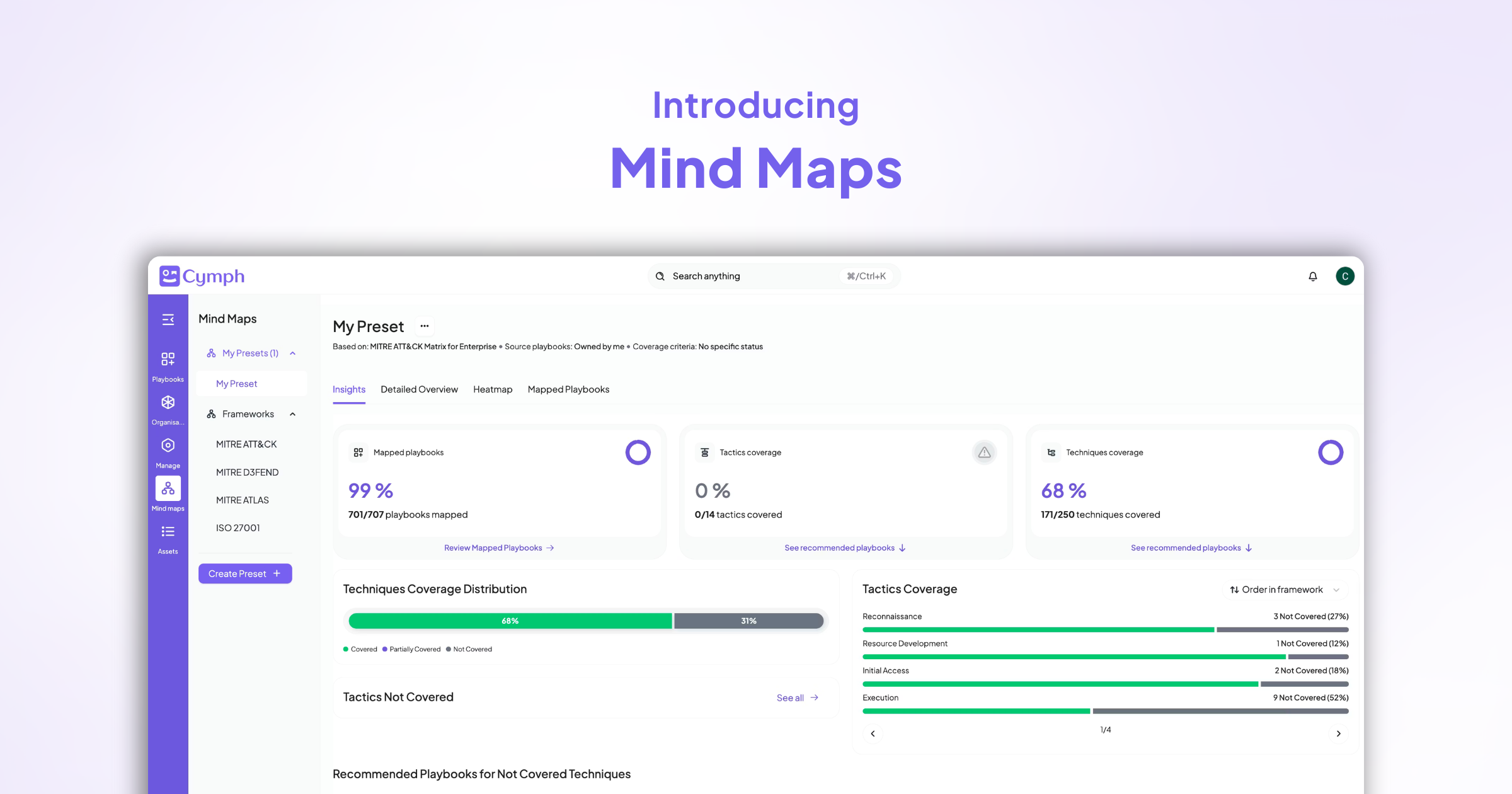
Once you've created a preset, Mind Maps provides immediate visibility through multiple visualisations.
See how well you're covered across different dimensions. For MITRE ATT&CK, this shows coverage by tactic (Initial Access, Execution, Persistence, etc.).
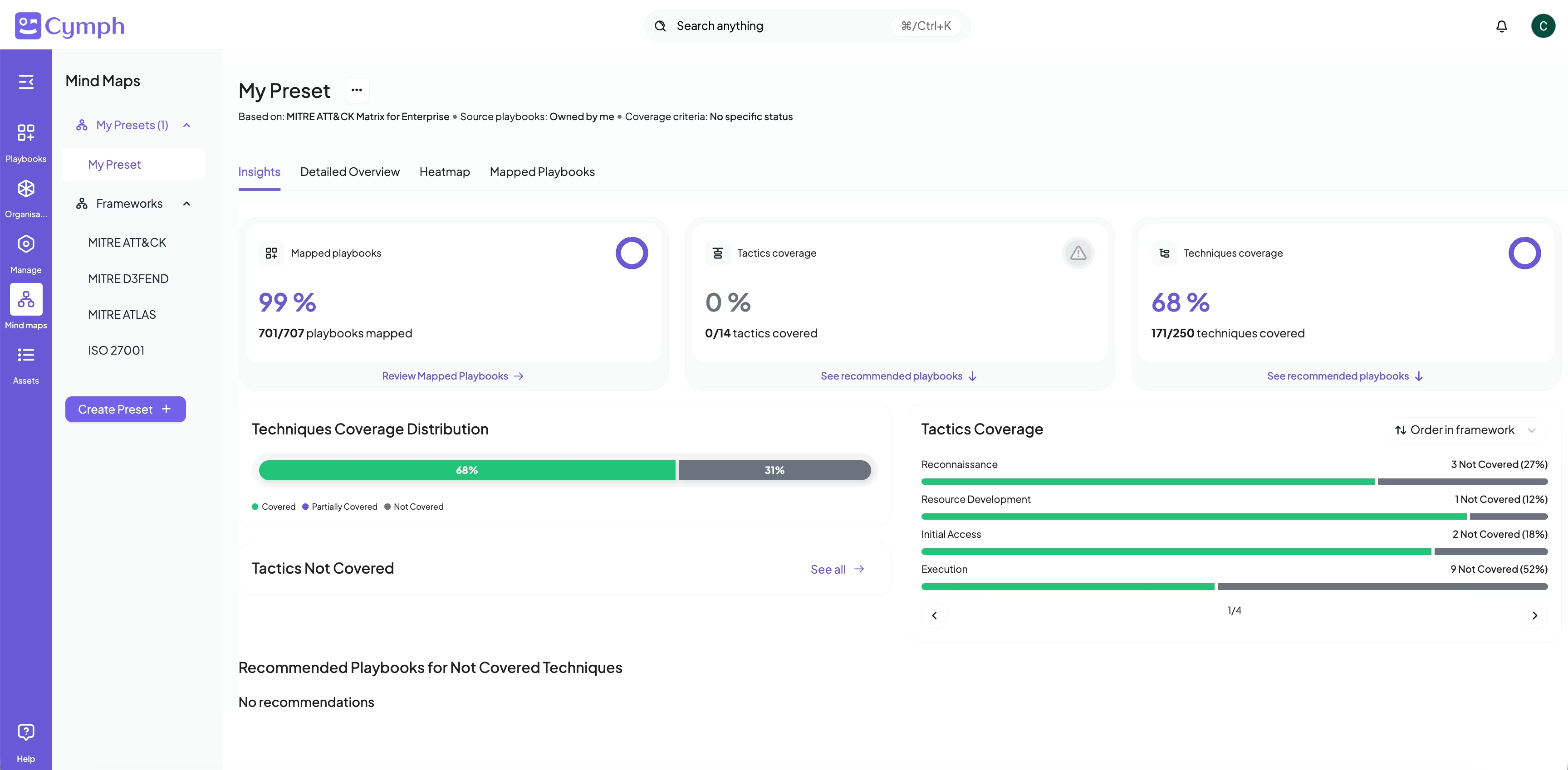
Dive into the details with a MITRE-style matrix shows each technique's status with clear colour coding:
- Green: Covered (at least one qualifying playbook addresses this technique, or all sub-techniques are covered)
- Purple: Partially covered (some sub-techniques are covered, but not all)
- Gray: Not covered (no playbooks address this technique or its sub-techniques)
Dynamic and always current
Any changes to your playbooks automatically update your coverage analysis. Add a new playbook and coverage updates immediately. Revoke or mark a playbook as draft, and it's excluded. Expired playbooks are automatically removed.
You always have an accurate view of your security posture without manual updates.
Closing the gaps
Identifying gaps is valuable, but the real question is: what do you do about them?
When you click on an uncovered technique, Mind Maps shows:
Recommended playbooks: Cymph's library contains 700+ public playbooks sourced from trusted sources like CISA and CERT Societe Generale, as well as template playbooks created by Cymph. Browse recommendations, duplicate one to your library, and customise it for your environment.
AI-generated playbooks (for MITRE ATT&CK): Automatically generate detection or mitigation playbooks when no existing playbook fits your needs.
This transforms gap analysis from a reporting exercise into an actionable workflow.
What Mind Maps can do for you
For SOC managers and SecOps teams
No more manual mapping, no more outdated coverage views, no more hunting through multiple systems to understand your defensive capabilities. Get instant and complete visibility into operational coverage through a single source of truth that stays current automatically. Quickly identify which attack techniques your team can detect and respond to, and which represent blind spots. Prioritise playbook development based on actual gaps rather than guesswork. Demonstrate coverage improvements over time.
For compliance and audits
Generate coverage reports in seconds, not weeks. When the board asks about your security posture or auditors request framework alignment evidence, you can produce comprehensive reports in PDF or JSON format immediately. No more scrambling to compile evidence or hoping your spreadsheet is current.
Real-world impact
Consider a security team that's built playbooks over two years across their SOAR platform and Confluence. When leadership asks about their MITRE ATT&CK coverage ahead of a board meeting, here's how Mind Maps changes the workflow:
Without Mind Maps:
- Hours or days gathering playbooks from various sources
- Manual mapping to techniques in spreadsheets
- Calculate coverage percentages
- Create visualisations
- Repeat when playbooks change
With Mind Maps:
- Import playbooks (automatic tagging happens immediately)
- Create preset for enterprise Windows environment
- View instant coverage showing 68% technique coverage
- Identify that Persistence and Privilege Escalation need attention
- Browse recommended playbooks
- Export PDF report
- Coverage updates automatically going forward
The difference is transformative. Weeks become minutes, and the analysis remains current without manual effort.
Get started with Mind Maps
Whether you're preparing for an audit, demonstrating security posture to stakeholders, or want better visibility into your defensive capabilities, Mind Maps provides the automated framework analysis you need.
From weeks to minutes. From static spreadsheets to dynamic, instant analysis. From questioning your coverage to knowing exactly where you stand. That's the power of Mind Maps.