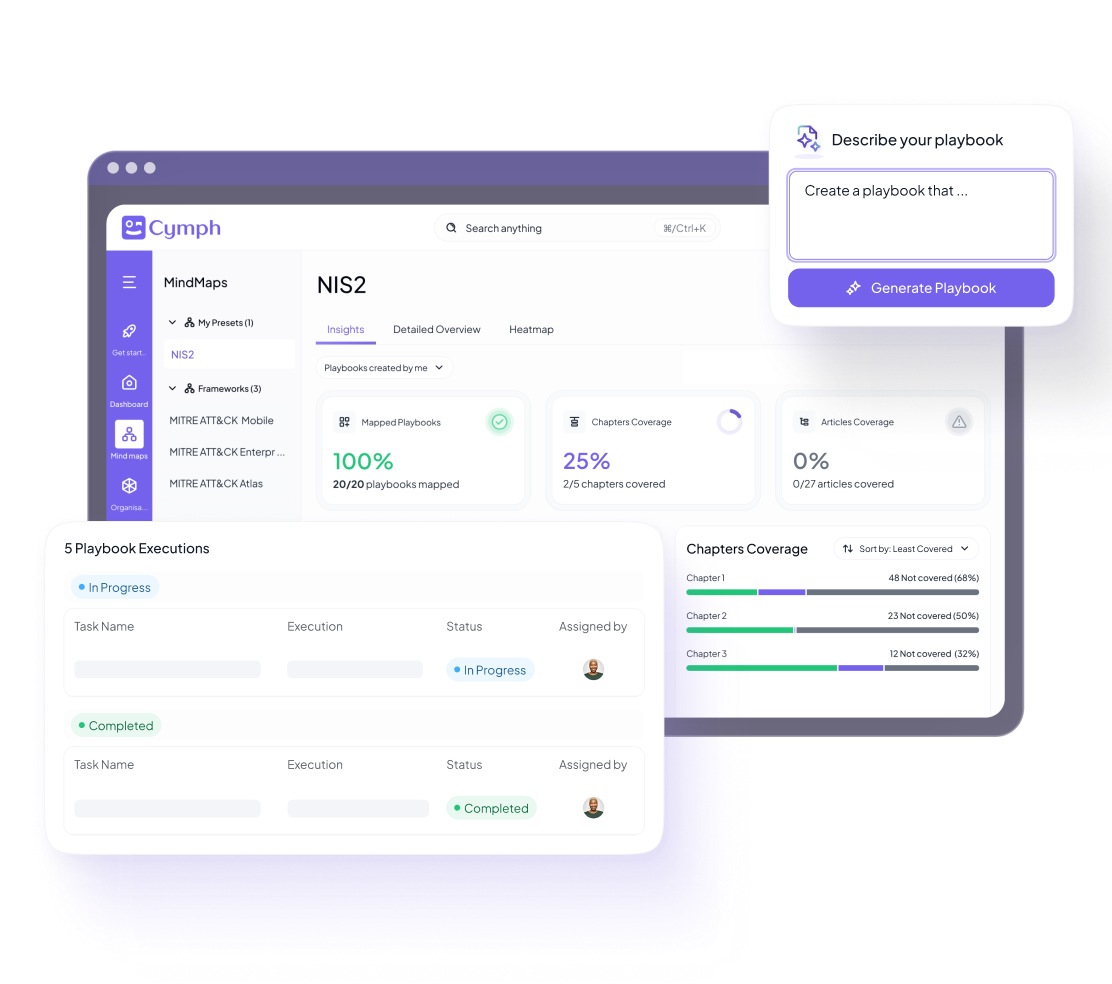
Incident Response Readiness for MSSPs
Run incident response gap analyses across multiple client environments, regardless of vendor mix, to increase analyst throughput and scale revenue without increasing headcount.
Manual effort limits incident response scale
Managing incident response across a growing client base means repeating consolidation, gap analysis, and remediation for every environment you support.

Gap analysis takes too long
Assessing each client's coverage means starting from scratch every time, across different tech stacks and tool sets. What takes days should take hours.
.svg)
Coordination never stops
Incident Response happens over email and phone calls. Clients are passive recipients of static reports. Every incident, update, or change requires manual back-and-forth. Time per client never goes down.
.svg)
Adapting to changes is slow
Writing new playbooks requires piecing together asset information, existing processes, and coverage gaps from disparate sources. Avoid the overhead of context switching between clients.

Audit readiness is a fire drill
Documenting what happened, who acted, when, and against which framework requirement is assembled retroactively from memory and logs. Every audit is expensive.
Scale your incident response capability, not your headcount
MSSPs use Cymph to deliver incident response readiness as a continuous, managed capability, serving more clients with the same team and running better incident response operations for each one.
Gap analysis the easy way
Ready in minutes, updated automatically.
- Vendor agnostic and ingestion from all sources for smooth onboarding.
- Automatic coverage mapping.
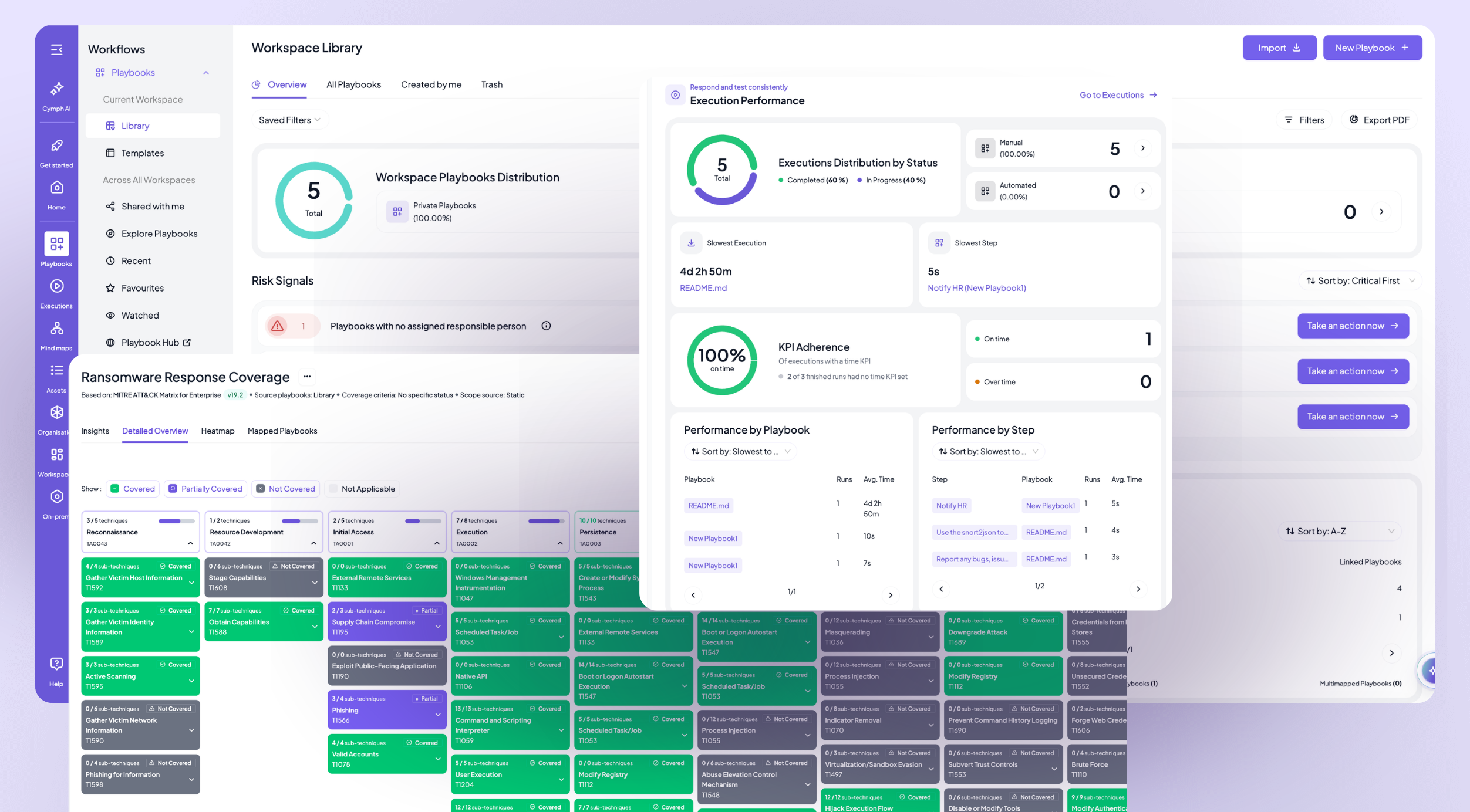
- Live view of what each client can detect and respond to, where the gaps are, and what’s needed to close them.
.png)
Replace the back-and-forth
Shared access and execution environment, client-visible posture, always-current playbooks.
- Coordination via a shared execution environment. Steps are assigned, tracked, and logged in real time.
- Clients have direct access to their latest playbooks, their assets, their coverage view.
- No more chasing status over email. Playbook updates are reflected immediately.
.png)
Create better playbooks faster
AI-assisted draft generation based on client context; analyst reviews and deploys.
- Cymph already holds the full picture: client assets, existing playbooks, MITRE coverage, active gaps.
- Generate a contextually grounded playbook draft from day one. You’re not starting from a blank page.
- Reviewing and refine a draft that already knows the client’s environment.
.png)
Audit evidence shouldn’t be a fire drill
Minutes, every playbook versioned, auto-documented and ready on demand.
- Cymph ingests playbooks from wherever they live and stores them in a single, structured, audit-ready format.
- Every playbook execution creates a timestamped audit log of every step taken, who performed it, and what the outcome was.
.png)
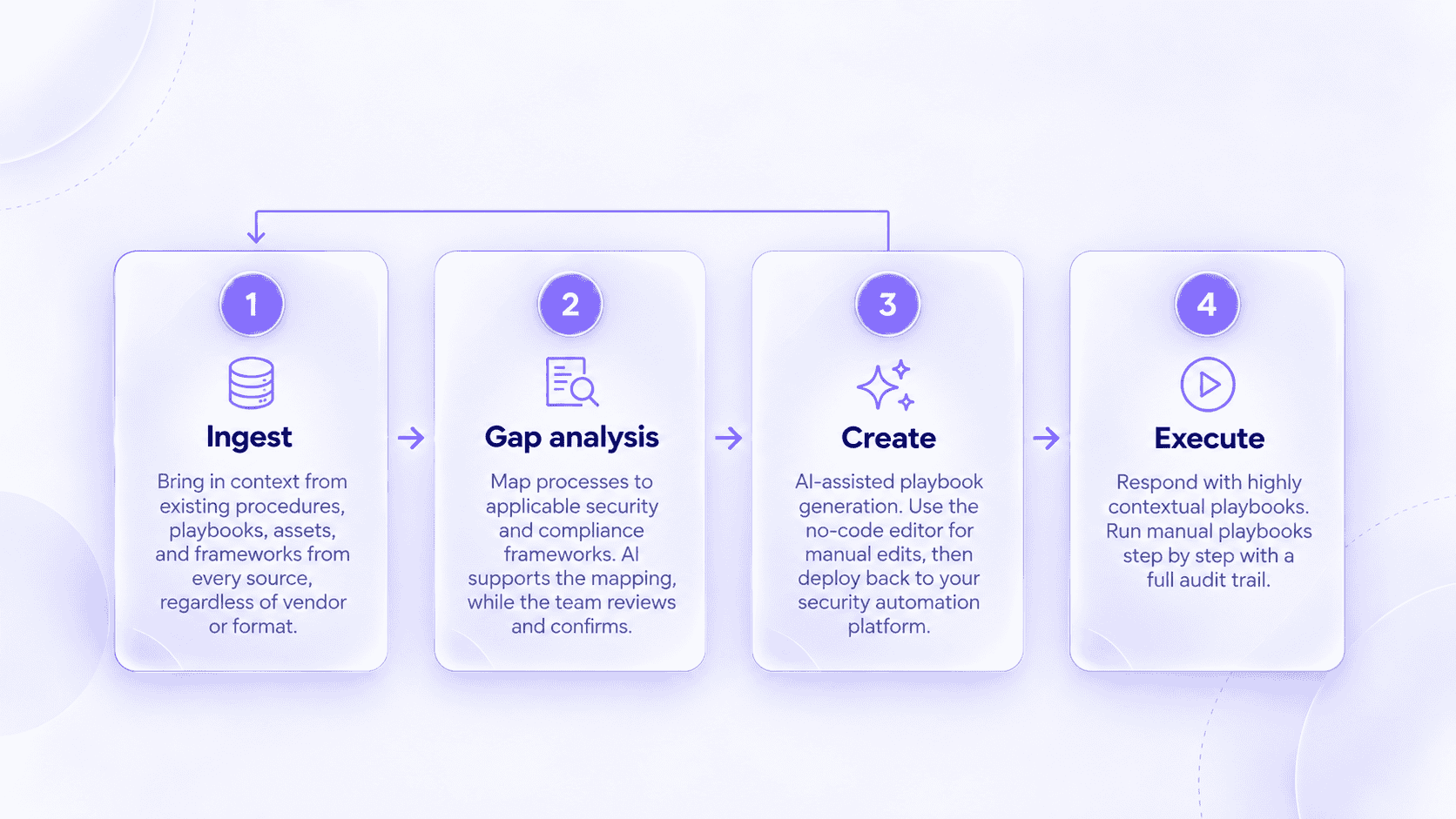
Assess, manage, and improve incident response readiness
Continuous loop, same workflow for every client. All from one platform.
Complete incident response readiness, at scale
No other solution gives MSSPs a complete, always-current view of every client's response coverage and the tools to close the gaps.
.svg)
Vendor-agnostic, full-stack ingestion: Cymph ingests procedures from every tool your organisation and your client use.
.svg)
Always current and audit-ready IR readiness state: coverage mapping updates automatically. No spreadsheets, no scripts, no point-in-time snapshots.
.svg)
Cover both manual procedures and automated playbooks equally: the full picture of each client's response coverage, not just the automated slice.
.svg)
From gap to remediation in one workflow: from identifying a gap to deploying a validated, complete procedure, in a single workflow, at scale.
Have questions?
Find answers below or contact us for other questions.
How does Cymph support multi-tenancy for MSSPs?
Cymph provides multi-tenancy through Workspaces. Each customer can be assigned a dedicated Workspace, providing a logically isolated environment for its data, users, playbooks, assets, integrations, executions and other operational information.
This allows an MSSP to manage multiple customers through a single Cymph deployment while maintaining clear separation between customer environments.
Is customer data isolated between Workspaces?
Yes. Workspaces provide data isolation between customers. Data belonging to one Workspace is not exposed to users operating within another Workspace unless it is explicitly shared through supported Cymph sharing mechanisms. This enables MSSPs to operate multiple customer environments within the same platform without mixing their operational data.
Can MSSP analysts access multiple customer Workspaces?
Yes. MSSP personnel can be granted access to the Workspaces they are responsible for, allowing analysts to work across multiple customer environments while each customer's data remains isolated within its Workspace. This provides centralised MSSP operations without sacrificing customer-level separation.
Can different customers have different framework requirements?
Yes. Framework Presets allow the relevant scope and coverage criteria to be configured independently. For example, one customer may focus on a subset of MITRE ATT&CK relevant to its infrastructure, while another may require a different ATT&CK scope or an ISO 27001-oriented assessment. This avoids applying the same generic checklist to every customer.