What's new in Cymph: feature release round-up Q3 2026
Cymph now covers the whole incident response: War Rooms to coordinate it, AI recommendations at decision steps, KPI targets for each execution, and detection coverage.


Incident response readiness doesn't end when an incident begins. Teams need to know their procedures are current, understand who's responsible, coordinate response activities, and capture lessons that improve their next response.
That's the direction Cymph has been evolving toward. Our latest releases bring incident coordination, real-time collaboration, AI-assisted decision-making, and continuous improvement together with the governance and readiness capabilities already in the platform.
Here's what's new.
War Rooms: run the incident, not just the playbook
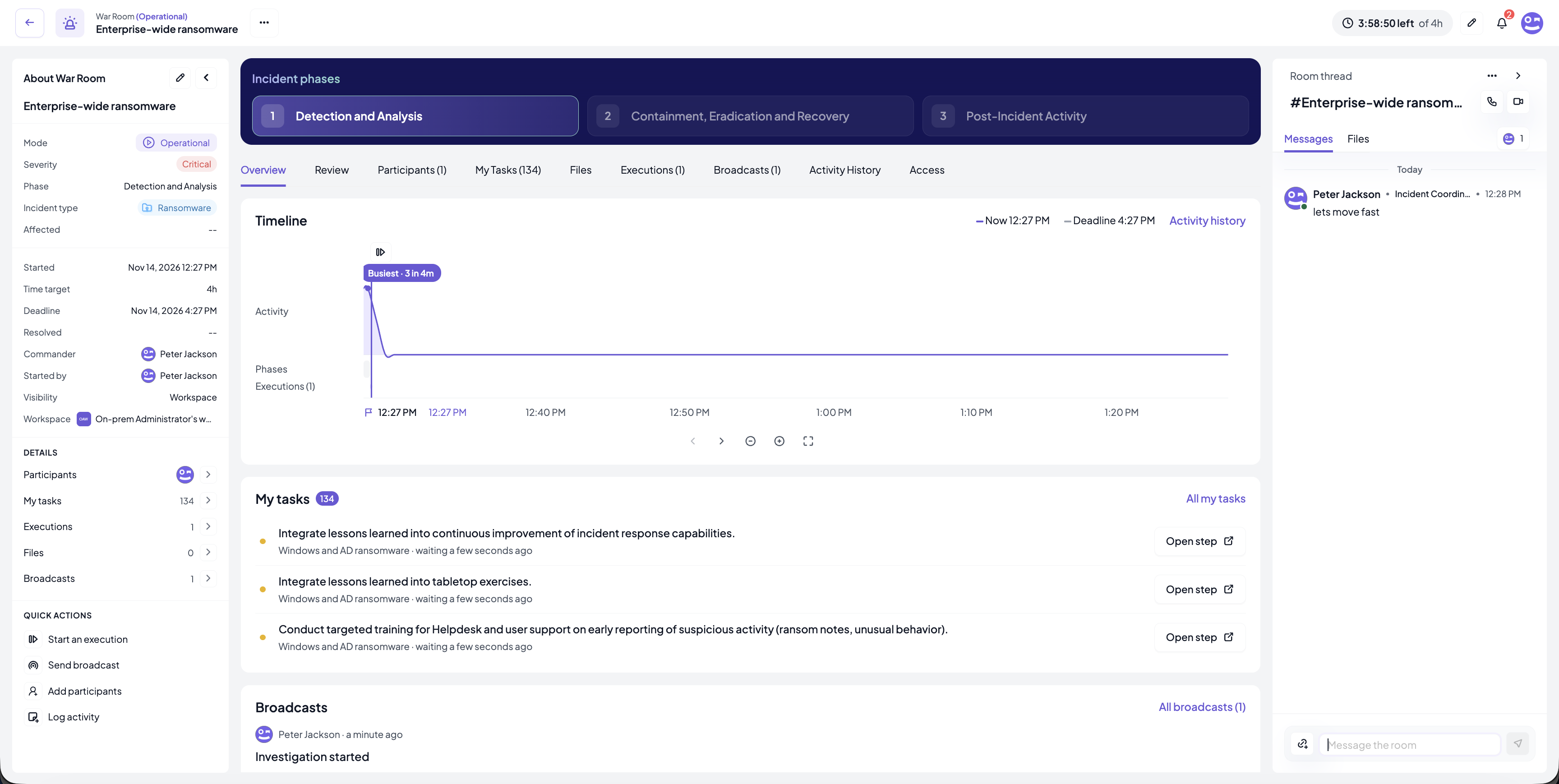
For smaller incidents, teams can execute a response playbook directly. For incidents requiring multiple responders, procedures, and coordinated decisions, War Rooms provide a central place to manage the response.
War Rooms bring it into Cymph. Start a room for a real incident or an exercise, add people or whole teams, and assign the roles that matter. Each room carries the facts of the incident (severity, incident type, affected services and assets) and moves through the NIST SP 800-61 phases, with a time target counting from start to resolution.
Everything that happens is captured as it happens:
- Executions started from the room are linked to it, and their assignees can join automatically.
- Activity history records who joined, what ran and what changed. Anyone in the room can add their own entries, such as a decision taken or an action completed.
- Files are treated as evidence, with a SHA-256 fingerprint at upload, a TLP level and every download recorded as a chain-of-custody event.
- Status updates go out to participants in-app, by email and by SMS, and to stakeholders outside the room.
- Chat and audio/video calls live inside the room, with calls encrypted end to end.
For sensitive cases such as an insider threat, a room can be restricted so that only its participants can see it, administrators included.
When the incident moves to Post-Incident Activity, Cymph opens a guided review built from the facts and timings of the room. The whole room can then be exported as a single archive: the activity history, the chat transcript, every file and a report per execution.
AI where the work happens
AI in Cymph is no longer a single feature. It now sits beside you across the platform, and it leaves the decisions with you.
- In-app assistant. A side panel with chat history and attachments, available wherever you are working.
- Playbook generation. Answer a few guided questions and get a draft playbook you can review and edit.
- Preset generation. Describe your organisation and let the assistant build a framework preset to start from.
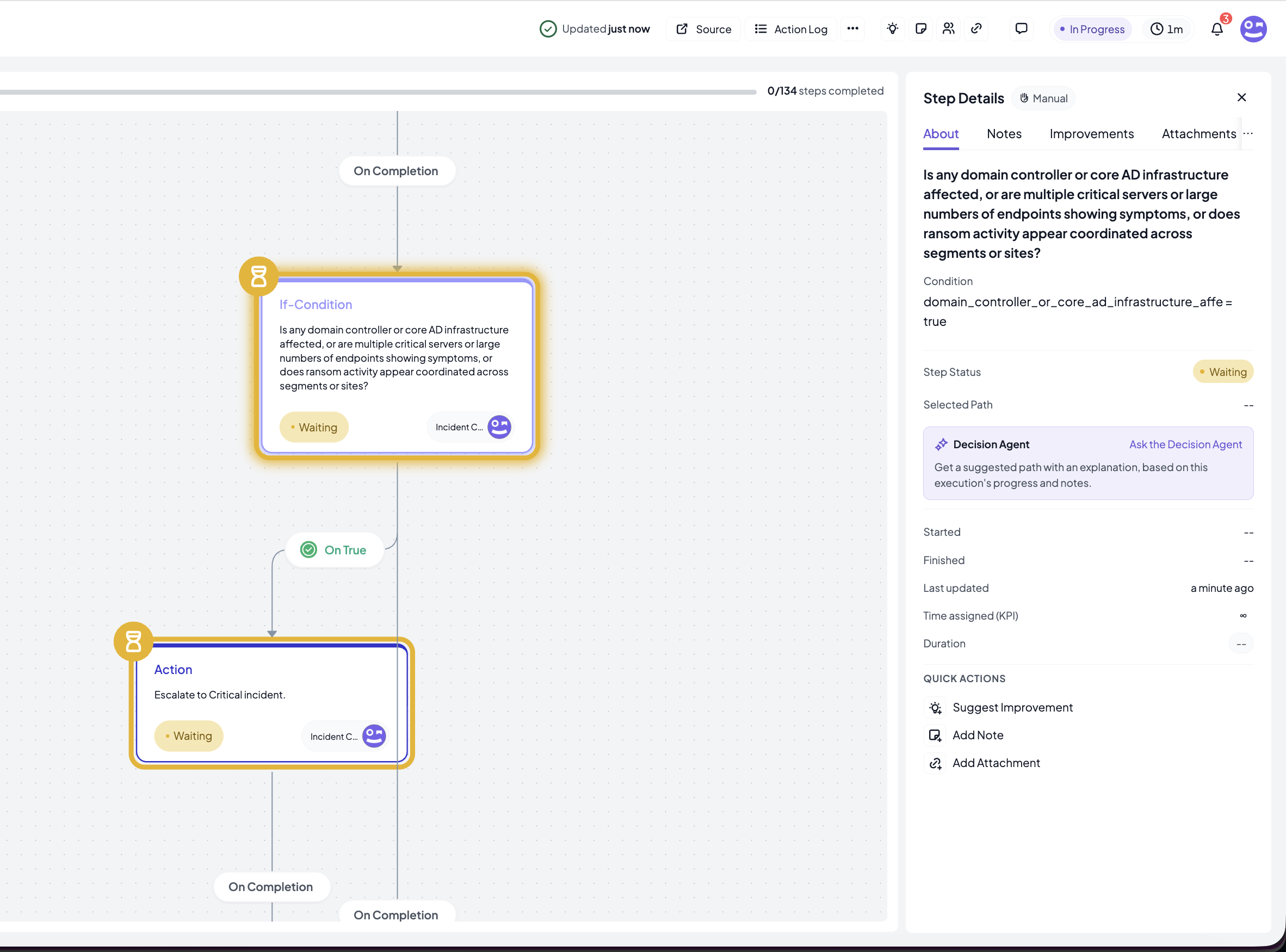
- Decision agents. On a judgement step of an execution, ask the AI which path to follow. You get a recommendation with its reasoning, and the choice stays with the person responsible.
- Suggested mappings. Framework techniques are suggested from the playbook's own content, and several playbooks can be mapped at once in the background.
One overview, measurable targets and a loop that closes
Knowing you have playbooks is not the same as knowing they work. Three additions make readiness something you can measure and improve.
The new overview brings governance, readiness, focus and execution panels into one view of your programme: what is covered, what needs review and where the risk signals are.
KPI targets put a clock on executions. Set a time target, track it live with per-step timers and see clearly when a target is breached. Performance goals can be adjusted as your team matures.
Improvement suggestions close the loop. Lessons raised during an execution now surface on the playbook itself, both for the whole run and for individual steps, with a link back to the execution they came from. A playbook changelog shows who changed what and when, and insights can be downloaded as PDF or Excel reports for audits and management reviews.

Detection coverage reaches more of your stack
In June we introduced detection-to-response coverage maps with Microsoft Sentinel and Wazuh. The same view now reads from far more sources:
- Splunk Enterprise Security
- Cortex XSIAM
- AWS
- Nessus
- Sigma rules
Scope can be imported directly from your connected sources, and validation is reported per source. When a detection rule carries a revoked or unknown technique ID, Cymph names the rule, suggests a fix and can skip the unknown IDs so the rest of your content still imports.
The framework library has grown as well, with MITRE ATT&CK for ICS, MITRE FiGHT, NIST AI RMF and the full set of DORA technical standards. Mappings are now stored per framework version, so you can keep older and newer versions side by side, and cross-mappings show coverage derived from other frameworks.
Get started
War Rooms, the AI capabilities, the new overview, KPI targets, improvement suggestions and the expanded detection coverage are all available now. If you're already using Cymph, log in and start your next incident or exercise in a War Room. If you're evaluating the platform, book a demo to see how Cymph supports a response from the first playbook to the post-incident review.